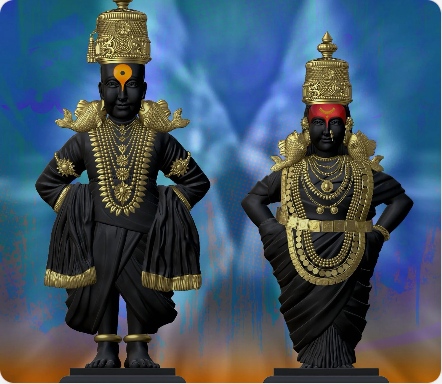
Lord Vittal
Shri Vitthal Maharaj—lovingly known as Panduranga or Vithoba—is revered as the Saguna manifestation of the Supreme Brahman.
Introduction
Pandharinath — The Lord Who Waits
Shri Vitthal Maharaj is revered all over the world by saints and devotees alike. He is an incarnation of Lord Vishnu, and Rakhumai (Rukmini), His consort, is of the form of Goddess Lakshmi.
Near, Not Distant
To His devotees, He is not distant or celestial, but near—waiting and accessible—the Lord who stands patiently for His bhaktas. In Maharashtrian bhakti tradition, Lord Vitthal appears in a uniquely compassionate and relational form, where bhakti supersedes ritual, caste, scholarship, and renunciation.
Pandharpur
The primary temple is in Pandharpur, Maharashtra, on the sacred banks of the Chandrabhaga (Bhima) river. The river curves like a crescent moon, symbolizing the embrace of divine grace around the Lord’s abode.
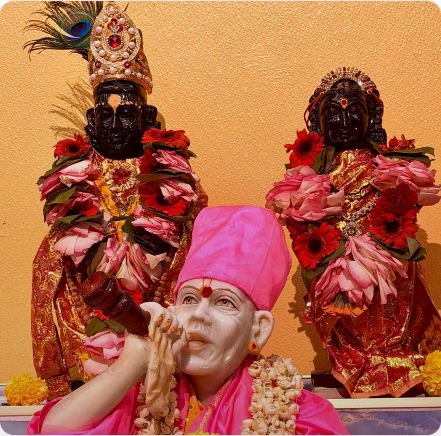
Prakat Leela
Pundalik and the Sacred Brick
Long ago, lived a man named Pundalik—learned and outwardly religious, yet inwardly restless. Seeking God far away in pilgrimages and rituals, he neglected something sacred: his aged parents.
The Turning Point
During pilgrimage, Pundalik witnessed a poor, aged couple being lovingly cared for by their son. Realization struck: serving parents with love is equal or superior to worshipping God. He returned home and transformed—every act became worship, every moment became prayer.
The Lord Waits
Moved by selfless service, Lord Vitthal arrived with Rakhumai. Yet Pundalik did not rush—he was massaging his parents’ tired feet. He gently rolled a brick (Vit) and said: “Please stand here.” God stood—patiently, joyfully—waiting on a brick. “Where such dharma exists, I will remain forever.”
Why “Vitthal”? The Lord who stood on a brick (Vit) became Vitthal—the God who waits upon devotees. The sacred place became Pandharpur, and He is lovingly called Pandharinath (Lord of Pandhari).
What This Story Teaches
Varkari Parampara
Lord Vitthal and the Maharashtrian Saints
Lord Vitthal is inseparable from the Varkari Sant Parampara, through whom He expressed compassion and philosophy. He did not create institutional disciples—He created living saints, awakened within ordinary life.
Foremost Saints
As Lived, Not Preached
Lord Vitthal’s Teachings
His teachings are embodied through leela and contemplation—gentle, gradual, rooted in daily life, saturated with love.
Teachings (Embodied)
The Varkari Path Emphasizes
Salvation on His path is: gradual, gentle, rooted in daily life, and saturated with love—rather than severe tapasya, scriptural mastery, or ascetic withdrawal.
Utsav
Festivals Celebrated in Honour of Lord Vitthal
Granth
Lord Vitthal Scriptures
True to being the humble Lord who patiently waits, there are not many authoritative texts, as it is not easy to capture His glory in words. Instead, He is revered through bhajans, abhangas, hymns, and devotional songs.
Texts and Sources